
Why Farmers Join Agribusiness Clusters
Agribusiness clusters are a type of farmer-centric organization designed to help smallholder farmers be more effective at commercializing their crop products by connecting to buyers, improving market access and stabilizing supply chains. A recent study published in Cogent Food & Agriculture, analyzed socioeconomic and institutional factors for sorghum growing households within Tharaka Nithi County in Kenya to identify what drives sustained participation in these clusters.
Results using data from 318 households, with just over 48% participating in clusters, show that adequate training on sorghum production practices is the strongest factor. Farmers without training were 19.5% less likely to join. Farming experience also matters, with each additional year increasing participation by 3%. Households with high dependency demands were much less likely to engage, highlighting labor and resource constraints. Surprisingly, gender, access to credit, and group membership had no significant effect.
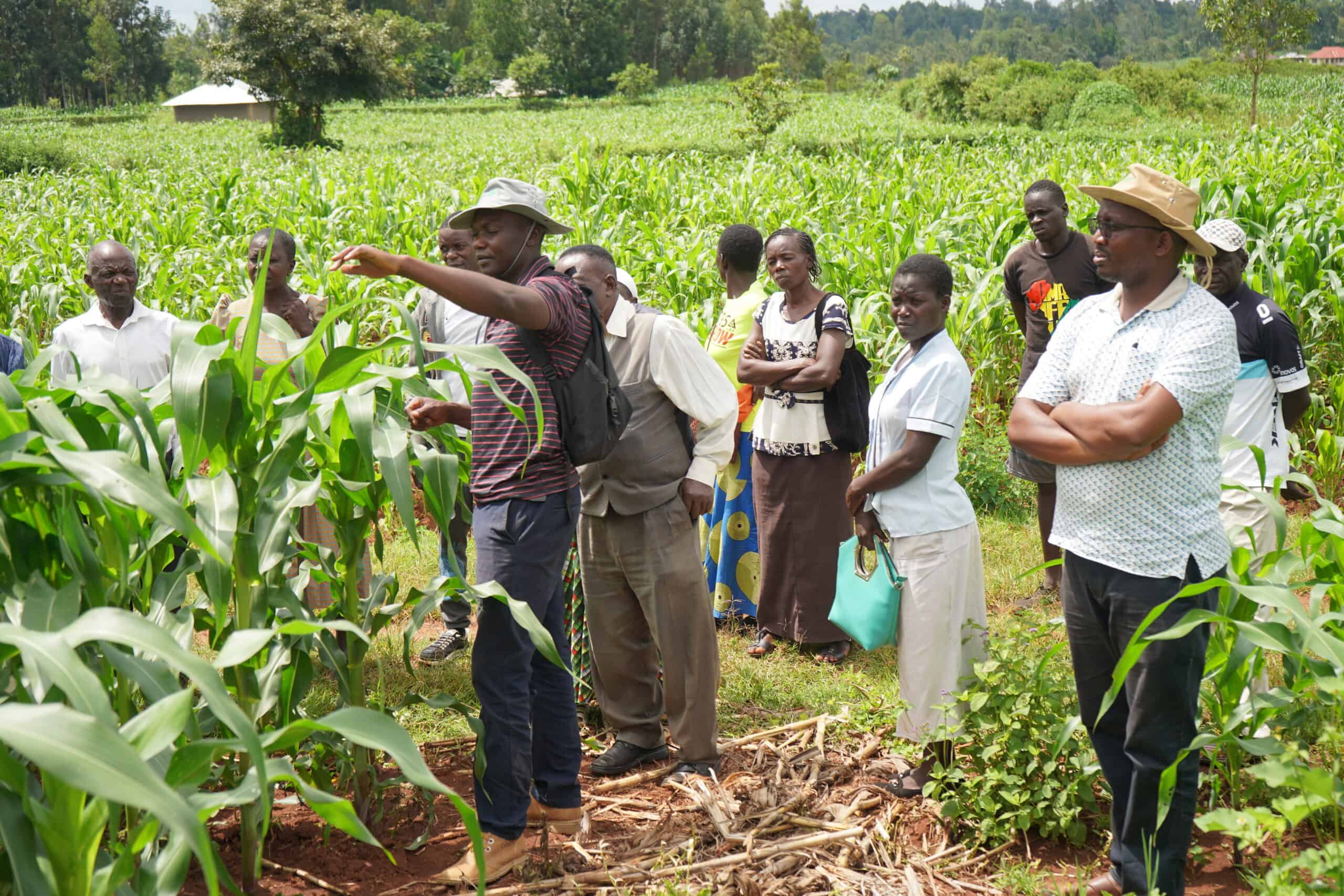
Farmer’s field day in Siaya county, Kenya.
The study recommends expanding inclusive training programs, targeted support for those households with higher numbers of dependents within the family unit and leveraging experienced farmers as mentors. These steps can strengthen cluster initiatives and, if sustained, contribute to livelihood improvement in this semi-arid farming system.
Policy implications emphasize the need to: i) expand high-quality training programs to build farmer confidence and technical capacity; ii) support high-dependency households through flexible interventions like time-saving technologies and subsidies; and iii) scale the leveraging of experienced farmers as mentors to encourage broader engagement.
Researchers concluded that participation in cluster initiatives is shaped more by knowledge and household structure than by financial access or social group membership. Strengthening capacity-building and inclusive support mechanisms can enhance commercialization and resilience amongst semi-arid farming systems and households.
“Agribusiness clusters are important platforms for inclusive value chain participation in smallholder farming systems. They offer vital incentives for the proliferation of self-sustaining farmer-led on-farm experimentation networks,” explained APNI Co-author Dr. Ivan Adolwa.
Acknowledgment
This summary was extracted from the article published by Susan Wabocha1, Ibrahim Macharia1, Ivan Solomon Adolwa2, and Christopher Kamau1. 2025. Socioeconomic and institutional determinants of smallholder farmers’ participation in cluster crop initiatives in arid and semi-arid areas: evidence from sorghum farmers in Tharaka Nithi County, Kenya, Cogent Food & Agriculture, 11:1, 2592368, https://doi.org/10.1080/23311932.2025.2592368
The authors are with the 1Department of Agricultural Economics, Kenyatta University; 2African Plant Nutrition Institute (APNI), Nairobi, Kenya.