
El Niño 2026: What a Very Strong Event Could Mean for African Agriculture
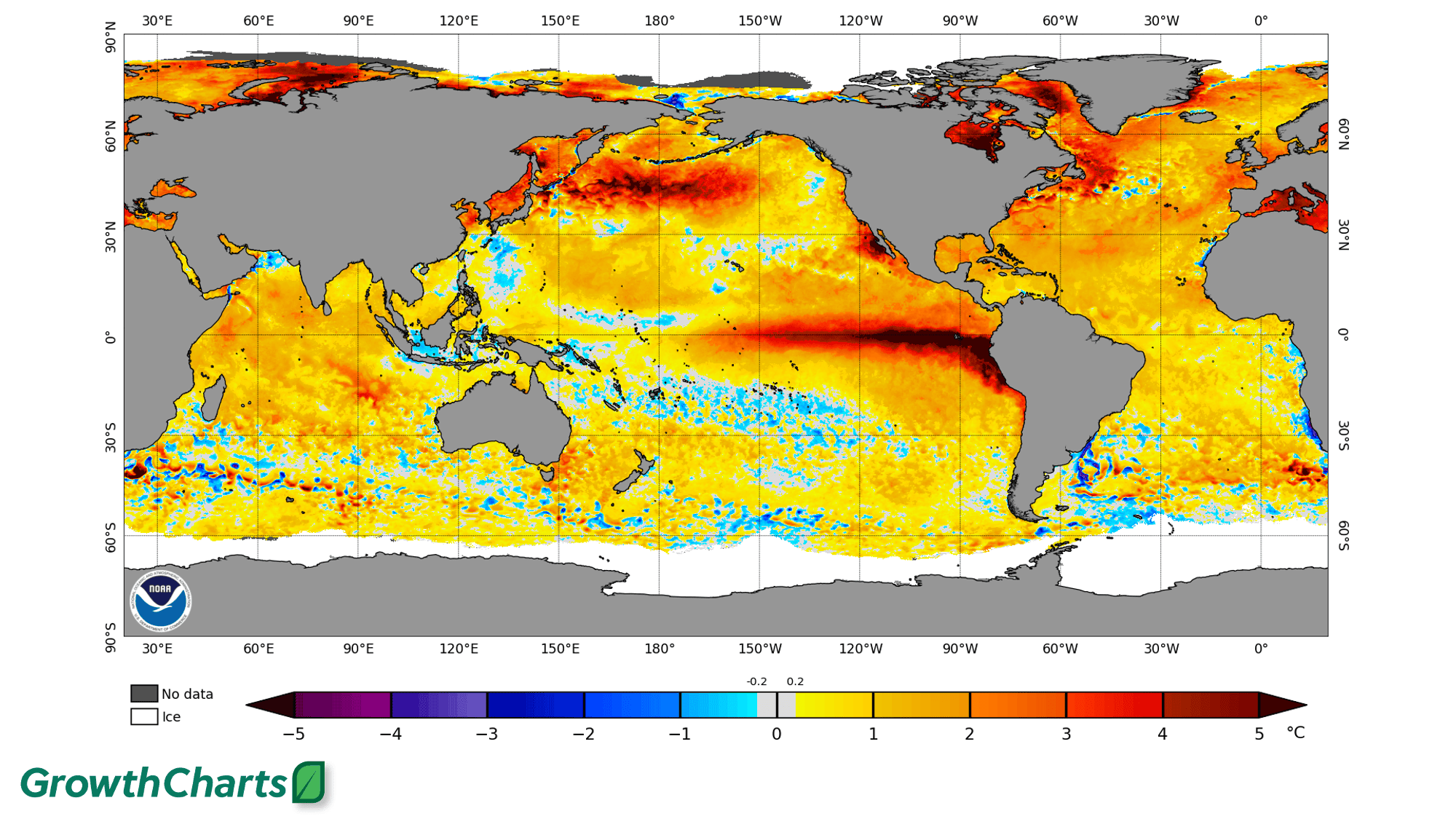
NOAA Coral Reef Watch Daily 5km SST Anomalies (v3.1) 7 Sep 2026. https://www.ncei.noaa.gov
Climate change is not the only uncertainty farmers must prepare for. In 2026, a familiar force has returned, and its effects could be felt across fields, markets and food systems throughout Africa.
The World Meteorological Organization (WMO) confirmed in its August 2026 update that El Niño is now firmly established in the tropical Pacific. Forecasts from WMO Global Producing Centres give a near 100% probability that the event will persist through February 2027, and most models expect it to reach very strong intensity before peaking towards the end of the year. Sea surface temperature anomalies in the Niño 3.4 region passed +2°C in July and kept rising through August. For African agriculture, this is far more than another weather forecast: the coming main season across much of the continent will unfold under a very strong El Niño.
The continent is already navigating rising temperatures, increasingly erratic rainfall, growing pressure on water resources and volatile input markets, and farmers, researchers and policymakers are still absorbing the costs of the 2023-2024 El Niño drought in Southern Africa, geopolitical instability and higher production costs. El Niño does not create a new set of problems. It amplifies the ones African agriculture is already facing.
El Niño is not a weather event but the warm phase of a coupled ocean-atmosphere cycle, the El Niño-Southern Oscillation (ENSO). It begins thousands of kilometres away in the tropical Pacific, where warmer-than-average sea surface temperatures shift the location of tropical convection and alter atmospheric circulation across the globe. These shifts influence rainfall, temperatures and extreme events on nearly every continent. The phenomenon is natural and has been documented for centuries, but it now operates on top of a warmer baseline. The same rainfall deficit produces more evaporative demand, more heat stress and faster depletion of soil water than it would have a few decades ago.
For Africa there is no single ‘El Niño effect’. Southern Africa has historically received below-normal rainfall during major events, and the timing matters: the expected peak in December to February coincides with flowering and grain filling of maize, the stage at which water stress does the most damage. In the 2023-2024 season, a mid-season dry spell during a moderate-to-strong El Niño cut maize harvests sharply in Zambia, Zimbabwe and Malawi, all three of which declared national disasters. Lower soil moisture, declining reservoir levels and heat stress can significantly reduce yields of staple crops such as maize while placing additional pressure on livestock.
Parts of East Africa, by contrast, tend to receive above-average rainfall during the October to December short rains, and this year a positive Indian Ocean Dipole is forecast alongside El Niño. That combination produced the destructive floods of late 1997 and late 2023, and it raises the risk of flooding, erosion, infrastructure damage and crop and livestock losses across Kenya, Somalia, Ethiopia and Tanzania. In West Africa and the Sahel, the signal is weaker and less consistent, which argues for region-specific preparation rather than continent-wide assumptions.
The implications extend well beyond individual farms. Agriculture remains Africa’s largest employer and the foundation of food security for hundreds of millions (M) of people. When rainfall becomes less predictable, every stage of production becomes more uncertain, from deciding when to plant to timing fertilizer applications and anticipating harvest volumes. Weather uncertainty quickly translates into economic uncertainty, affecting input suppliers, traders, processors and consumers alike.
That uncertainty is already visible in global food markets. The FAO Food Price Index (FFPI) recently reached its highest level in August 2026 (133.3 points) since November 2022, reflecting the combined effects of extreme weather, geopolitical tensions and concerns over agricultural production. A strengthening El Niño could push food prices higher by reducing yields in key producing regions and raising the cost of inputs, freight and energy.
Plant nutrition sits at the centre of this problem. Climate variability changes not only how crops grow but also how efficiently they use nutrients. During drought, limited soil moisture restricts root growth and slows the mass flow and diffusion of nutrients to the root surface, so applied fertilizer stays where it was placed and much of it is never taken up. Nitrogen applied ahead of rains that do not come is money lost, and once the rains do return it is nitrogen lost to the environment.
Intense rainfall does the opposite: it moves nutrients off the field through runoff and erosion, or below the root zone through leaching, before crops can use them. Waterlogged soils also lose nitrogen as gas through denitrification. Either way the result is lower nutrient-use efficiency, reduced productivity and higher environmental losses.
Fixed fertilizer recommendations cannot cope with this. Adaptive nutrient management can. Integrated Soil Fertility Management (ISFM) and 4R Nutrient Stewardship (right source, rate, time and place) were designed for exactly this kind of decision. In a drought-prone season that means favouring split applications, holding back part of the nitrogen until crop establishment is confirmed, and placing fertilizer where roots can reach it under limited moisture. In a flood-prone season it means avoiding early broadcast applications, protecting soil cover, and timing topdressings to follow rather than precede heavy rain. Seasonal forecasts, better soil information and site-specific advisories can help farmers make these decisions as rainfall becomes less predictable, provided the information reaches them in time and in a form they can act on.
Resilience extends well beyond fertilizer, of course. Building agricultural systems capable of withstanding climate shocks requires investments in drought-tolerant crop varieties, improved water management, healthy soils, digital climate services and stronger agricultural extension systems. In June, FAO and the World Food Programme (WFP) launched a US$202 M joint anticipatory action appeal to protect up to 8.8 M people across 22 high-risk countries before impacts escalate into humanitarian crises, and WFP has since triggered anticipatory action plans in South Sudan, Chad, Mauritania and Uganda, among others.
The case for early action is strong. WFP’s analysis of 45 food-insecure countries projects that this El Niño could push at least 49 million more people into acute food insecurity by the end of 2027, raising the total in those countries from roughly 225 M to 274 M. Southern Africa is among the regions most at risk, and West and Central Africa could see close to 6 M additional people affected. Every dollar spent on anticipatory action is estimated to save three to seven dollars in later losses and response costs.
El Niño will pass. What it reveals will not. African farming systems are entering an era in which climate variability is the norm rather than the exception, and each event tests how far the sector has moved from reaction towards preparation. The 2023-2024 event caught much of Southern Africa with depleted reserves and little in-season flexibility. The question for 2026-2027 is whether the lessons of that season, and of 2015-2016 before it, have been turned into practice.
Resilience is built long before the rains arrive. Continued investment in science, climate services, sustainable plant nutrition and farmer-centred innovation will not stop the next El Niño, but it will decide how much damage it does. That is the message of 2026 for African agriculture, and for the increasingly variable climate that lies ahead.
Authors: Sara Lamsili (e-mail: s.lamsili@apni.net) APNI Project Communication Manager, and Brayan Valencia (e-mail: b.valencia@apni.net) APNI GIS Analyst and Hydrologist based in Benguérir, Morocco.