
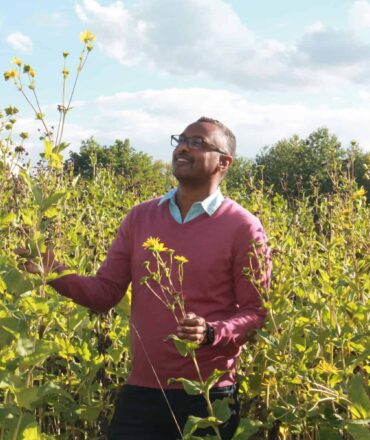
Dr. Khatab M. Abdalla
- EMAIL ADDRESS: k.abdalla@apni.net
- LOCATION: ICIPE COMPOUND, BOX 30772, NAIROBI, KENYA
Dr. Khatab M. Abdalla is a soil scientist with extensive research experience in soil ecology, biogeochemistry, soil and land degradation, and sustainable land management. He received his B.Sc. (Honours) and M.Sc. degrees in Agriculture from the University of Khartoum in Sudan, and his Ph.D. in Soil Science from the University of KwaZulu-Natal in South Africa. He began his career as a researcher at the Environment, Natural Resources and Desertification Research Institute (ENDRI) at the National Centre for Research in Sudan. Following his Ph.D., he held postdoctoral and research associate positions at the University of KwaZulu-Natal in South Africa and the University of Bayreuth in Germany. He also served as an Assistant and Associate Professor at the National Center for Research in Sudan. His main research interests focus on how land use, agricultural management, and soil–plant–microbe interactions regulate soil organic matter and nutrient dynamics, particularly carbon and nitrogen. More specifically, his research covers soil matter decomposition and stabilization, greenhouse gas fluxes, and rhizosphere processes, including aggregate formation and rhizosphere priming effects, as well as nitrate leaching. He combines stable isotope techniques, laboratory incubation with field experiments to understand the mechanisms linking agricultural management with soil health, climate resilience and sustainable productivity.
He has authored numerous scientific papers in peer-reviewed journals and contributed to scientific reports and greenhouse gas accounting methodologies. He also has experience in postgraduate teaching and student supervision and has served as an external examiner for M.Sc. and Ph.D. theses.
At the African Plant Nutrition Institute (APNI), he serves as a Senior Scientist – Agriculture for Environmental Services. His work focuses on linking plant nutrition and soil health with sustainable land management and broader ecosystem functioning to deliver multiple agricultural and environmental benefits across African farming systems.