

SOLUTION PATHWAY 2:
Innovating Crop Nutrition for Diverse Cropping Systems
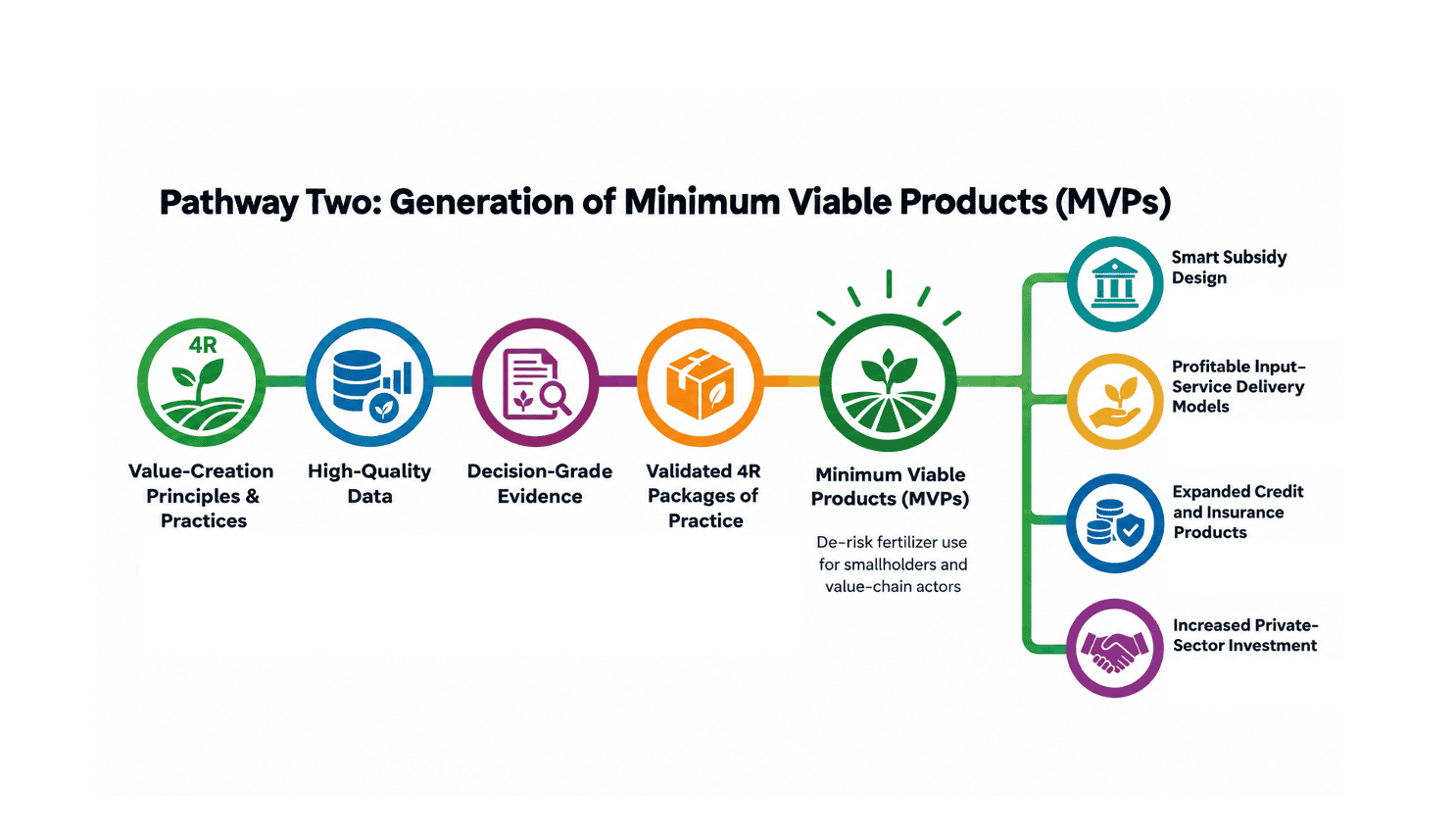
This pathway establishes the 4R framework as a systemic approach to optimizing performance across agro-ecologies and cropping systems. By generating intervention intelligence, it calibrates nutrient use to water availability and return on investment (ROI), producing validated business cases and data-driven tools that de-risk fertilizer use for smallholders and enable responsible private-sector engagement.
Pathway Priorities:
- Calibrate nutrient application to water availability, including rainfall, irrigation, and soil moisture dynamics, to optimize nutrient use efficiency, water productivity, and yield stability.
- Optimize nutrient management by explicitly accounting for spatial and temporal variability within cropping systems, including interactions in intercropping and crop rotation arrangements.
- Generate location-specific ROI, yield-gap, and risk analyses that provide a clear economic rationale for sustainable nutrient management and investment decisions.
- Quantify and optimize root–water–nutrient interactions so that economic projections reflect crop performance under stress and climate variability.
- Generate Minimum Viable Products (MVPs), that combine value-creation principles, practices, high-quality data, and decision-grade evidence to de-risk fertilizer use for smallholders and value-chain actors.
Stories

Q&A: Driving Sustainable Farming Through Legume Intensification
As sub-Saharan Africa faces rising food demands, declining soil fertility, and the need for climate-smart solutions, APNI’s project on Legume-Driven ...
Related Research