
Insights on Sustainable Olive Systems at SIAM 2026
APNI held a seminar session on “Soil Health to Food Resilience and Sovereignty: Insights from Olive Tree Functional Dynamics and Fertilizer Inputs for a Sustainable Olive System in Morocco,” during the 18th Edition of International Agricultural Exposition (SIAM) held between April 20 to 28, 2026 in Meknès, Morocco. During 2026, SIAM’s main theme is “Sustainability of Animal Production and Food Sovereignty.” It is considered Africa’s largest agricultural gathering that attracts 1,500+ exhibitors, and visitors from 70 participating countries.
The event featured speakers currently leading olive research activities in North Africa. Dr. Hakim Boulal, APNI Senior Scientist and Regional Coordinator for North Africa served as moderator for leading the engaging discussion on olive’s overall contribution and strategies to gain sustainability through better nutrient management.
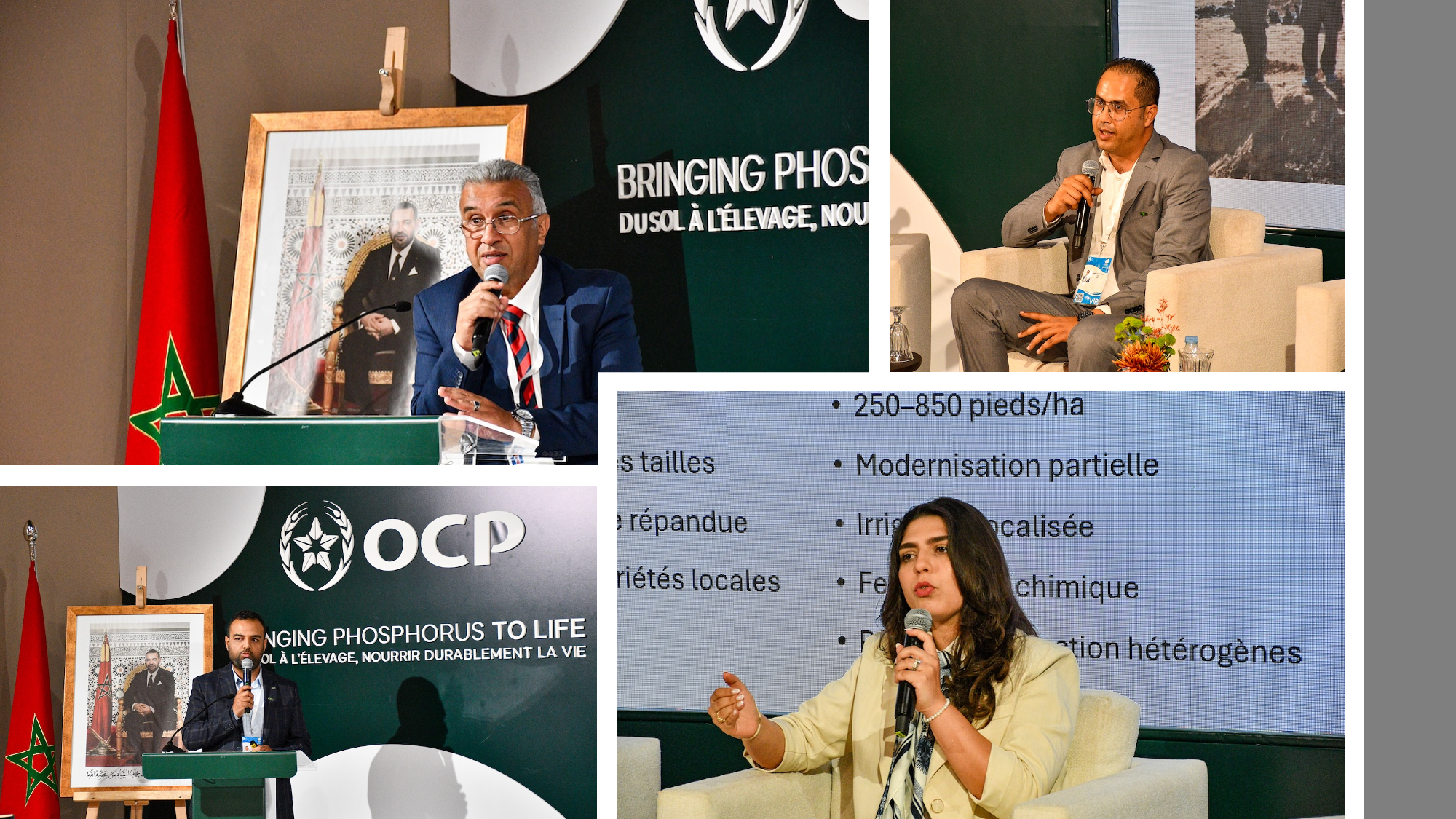
Session speakers (clockwise starting top left): Dr. Hakim Boulal, Dr. Amine El Khouni, Mr. Mahdi Dahane, Ms. Intissare Mouamine
APNI Agronomist, Mahdi Dahane, underscored the olive tree’s role as a defining historical, social, and territorial pillar in North Africa. “In Morocco and Tunisia, olive production systems are increasingly challenged by climate change, soil degradation, and management constraints.” In response, APNI is advancing research and development initiatives in both countries to enhance productivity, improve oil quality, and strengthen resilience through optimized soil, water, and nutrient management.
Intissare Mouamine, provided her perspectives as a PhD student working on APNI research on nitrogen (N) dynamics within the diverse olive systems of Morocco. “Nutrient management as one of the most critical challenges affecting the sustainability of olive systems. Striking a balance between productivity and sustainability—particularly in nitrogen management—remains complex.” Through a combination of farmer insights, landscape diagnostics, and on-farm experimentation, APNI’s ongoing project in the province of Ouazzane is generating practical, research-driven solutions to better address this challenge.
Dr. Amine El Khouni, APNI Associate Scientist, emphasized that olive trees offer more than just fruit and oil—they also hold significant potential for carbon sequestration. “Our findings from the province of Sfax, Tunisia reveal that excavation methods applied to centenary trees provide valuable insights into carbon fixation capacity and biomass distribution.” These insights support the broader goal of achieving healthy products from healthy trees grown in healthy soils.
More information on APNI research programs can be found at www.apni.net/research.