
Africa’s Resilience to Fertilizer Crises and Global Shocks
Recent global events have underscored the vulnerability of agricultural systems to external shocks. The fertilizer crisis, driven by disruptions linked to the COVID-19 pandemic and the Russia-Ukraine conflict, led to sharp increases in fertilizer prices and significant supply constraints. For Africa, where agricultural production already operates under tight input conditions, these disruptions had immediate and far-reaching consequences.
Fertilizers remain a critical component of agricultural productivity, contributing substantially to crop yields worldwide. However, fertilizer use across Africa is considerably lower than the global average, reflecting long-standing challenges related to affordability, access, and infrastructure. In this context, the fertilizer crisis did not introduce new weaknesses as much as it amplified existing ones.
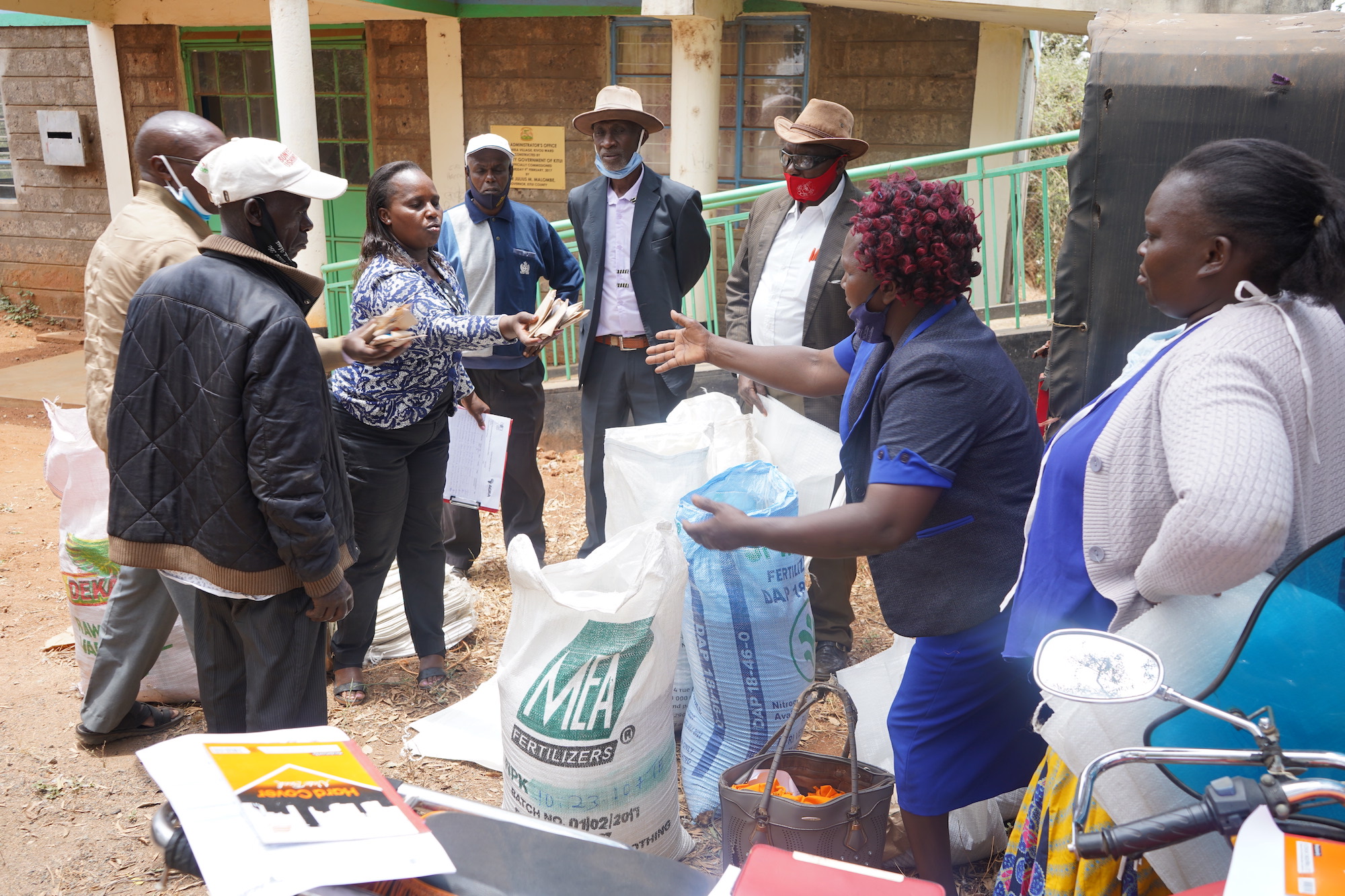
Farmers in Eastern Kenya receiving fertilizer and seeds as part of the Covid-19 support program implemented by APNI.
Recently published in International Food and Agribusiness Management Review, a comparative analysis across Kenya, Ghana, and Morocco provides timely insights into how these distinct systems responded to the same global shock. These countries represent distinct fertilizer market structures typical across much of Africa. Ghana operates a largely subsidy-driven system with full reliance on imports. Kenya’s market is more liberalized, with a strong role for private sector distribution but still dependent on imports. Morocco, by contrast, benefits from domestic fertilizer production and a more centralized, state-supported system. These structural differences shaped how the crisis was experienced at both national and farm-levels.
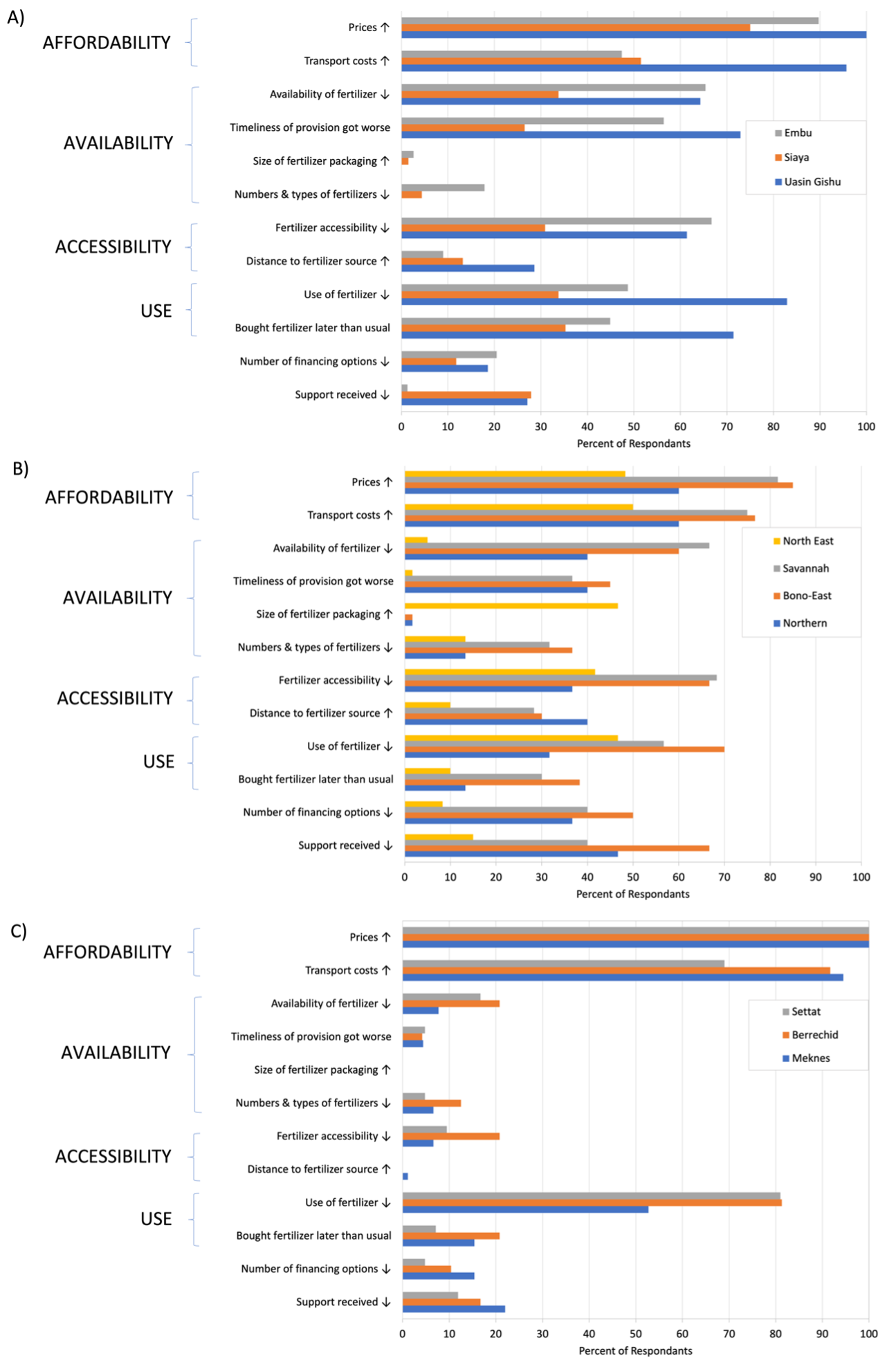
Effects of the fertilizer crisis on affordability, availability, accessibility, and use of fertilizers among surveyed households in (A) Kenya, (B) Ghana and (C) Morocco (Njoroge et al. 2026).
Fragile Supply Chains Force Compromise
Across all three countries, APNI Scientists found fertilizer affordability to be the most immediate constraint. Price increases were widespread and often substantial, accompanied by rising transport costs. Availability also declined in several regions, particularly in Ghana and Kenya, where supply chains were more exposed to international disruptions. Accessibility was further affected as farmers faced delays and, in some cases, had to travel longer distances to secure inputs. Even in contexts where fertilizers remained available, the timing and reliability of supply were compromised.
“These constraints translated directly into changes in farmer behavior. Many farmers reduced the quantities of fertilizer applied, delayed purchases, or adjusted cropping decisions, explains Dr. Samuel Njoroge, APNI Scientist and Lead Author. “In some cases, farmers reduced the area under cultivation or shifted to crops requiring fewer inputs.”
While such responses reflect a degree of adaptability, they also point to likely declines in productivity, given the well-established relationship between nutrient application and crop yields.
The study also highlighted important differences in how farmers were able to respond. Farmers with access to credit or diversified income sources were generally better positioned to maintain input use, even if at reduced levels. In contrast, more resource-constrained households had limited capacity to adapt and were more likely to reduce or abandon fertilizer use altogether. These differences underline the importance of considering heterogeneity among farmers when assessing the impact of input shocks.
At the national level, governments implemented a range of measures to mitigate the effects of the crisis. These included fertilizer subsidies, price controls, and credit support mechanisms. While such interventions provided short-term relief, they were not sufficient to fully offset the impact of rising global prices. In some cases, fiscal constraints limited the effectiveness or sustainability of these measures, highlighting the limitations of relying primarily on subsidies as a response strategy.
Morocco’s relatively stronger performance in maintaining fertilizer availability illustrates the role of domestic production capacity and coordinated distribution systems in enhancing resilience. In contrast, the greater disruptions observed in Ghana and Kenya reflect the risks associated with high import dependence and less integrated supply chains. These findings suggest that system-level characteristics play a critical role in determining the extent to which global shocks are transmitted to farmers.
Broader Implications
Africa’s exposure to global fertilizer markets represents a structural vulnerability. Supply chain disruptions, price volatility, and limited bargaining power in international markets can quickly translate into reduced input use and, ultimately, lower agricultural output. Addressing this challenge requires moving beyond short-term responses and focusing on longer-term system strengthening.
This includes expanding local and regional fertilizer production, improving infrastructure and distribution networks, and designing more targeted and efficient support mechanisms for farmers. It also requires strengthening the enabling environment for private sector participation while ensuring that smallholder farmers can access inputs in a timely and affordable manner.
Ultimately, the fertilizer crisis provides a clear illustration of how global shocks interact with local system constraints. While the immediate effects were significant, the more important lesson lies in understanding the underlying structural factors that shaped these outcomes. Strengthening resilience in African agriculture will depend on addressing these structural issues in a sustained and coordinated manner.
Acknowledgment
This summary was extracted from the article published by 1Samuel Njoroge, 2Esther Mugi-Ngenga, 3Pauline Chivenge, 4Hakim Boulal, 5Pamela Pali, 6Shamie Zingore, and 7Kaushik Majumdar. Impacts of the global fertilizer crisis in Africa: insights from country-level studies. International Food and Agribusiness Management Review. Published online February 24, 2026:1-32. doi:10.22434/ifamr.1370
The authors are: 1Scientist, 2Associate Scientist, 5Senior Scientist, African Plant Nutrition Institute (APNI), ICIPE Campus, 30772-00100 Nairobi, Kenya. 4Senior Scientist, APNI, P.O. Box 589, 26000 Settat, Morocco. 3Principal Scientist, APNI, Current address: International Rice Research Institute, P.O. Box 34441, Dar es Salaam, Tanzania. 6Director, Research & Development, 7Director General, APNI, Lot 660 Hay Moulay Rachid, 43150 Benguérir, Morocco.